


How a futurist reads AI news. (Hint: ignore most of it.)
Most of what you read about AI doesn’t matter. Not because it’s fake or wrong, (most of it is perfectly true), but because it’s daily news cycle noise that doesn’t matter in the long run. Just look at the major AI news narratives of the past month:
AI is overrated! Jobs are toast! Tokens are too expensive! The government is banning AI models! A new free Chinese model will destroy US labs! AI vendors are inflated! Agentic AI is here! AI agents are out of control!
A big part of my job as Citrix’s futurist is to ignore all this.
Narrowing the cone of uncertainty
Most people think a futurist’s job is to predict the future. (Fair!) It’s actually not, mainly because predicting the future is really hard, and if I could then I would be a Polymarket billionaire and wouldn’t even need a job.
A futurist’s actual job is to look at the entire range of futures, figure out which ones are most likely, and help the people who depend on me (colleagues, customers, partners, and investors) make decisions about where to invest time, money, and attention based on the parts of the future most likely to be true regardless of which version we end up with.
The hurricane forecasting analogy works well here. Meteorologists don’t know exactly where the hurricane will be each day and instead provide a range of possibilities which become less certain the further they go out. Meteorologists with better skills, experience, tools, and data are able to provide more certainty, reducing the range of options so the people who depend on them can focus on the areas most likely to be hit.
Similarly, every AI news story contains data points that can be extrapolated to a certain future and plotted out over time:
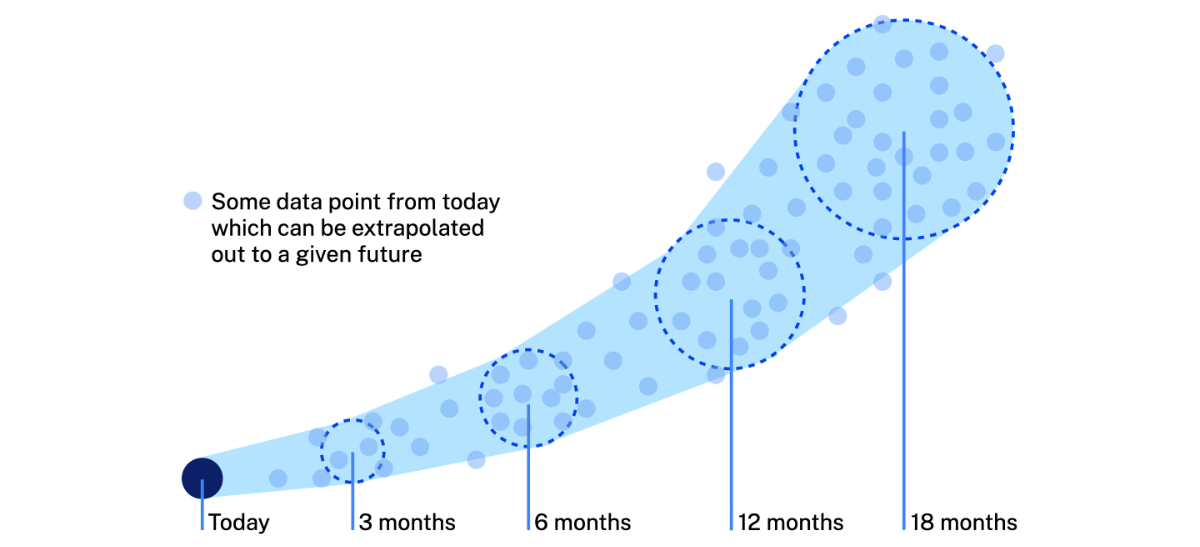

Then you can “connect the dots” to create story narratives. Each dot likely spawns multiple narratives over multiple paths, such as:
- AI is expensive → Companies will use it less → . . .
- AI is expensive → Labs will have an incentive to make it cheaper → Companies will use it more → . . .
- AI is expensive → Only the biggest companies will use it → . . .
- AI is expensive → It will get cheaper → Jevon’s paradox means companies will still want to use the most expensive → . . .
- And so on . . .
You can really have a lot of fun thinking through all the various future paths. (This is a great thing to brainstorm with your AI.) There are literally thousands of paths depending on what you take into consideration, how far out you go, and how granular you get:
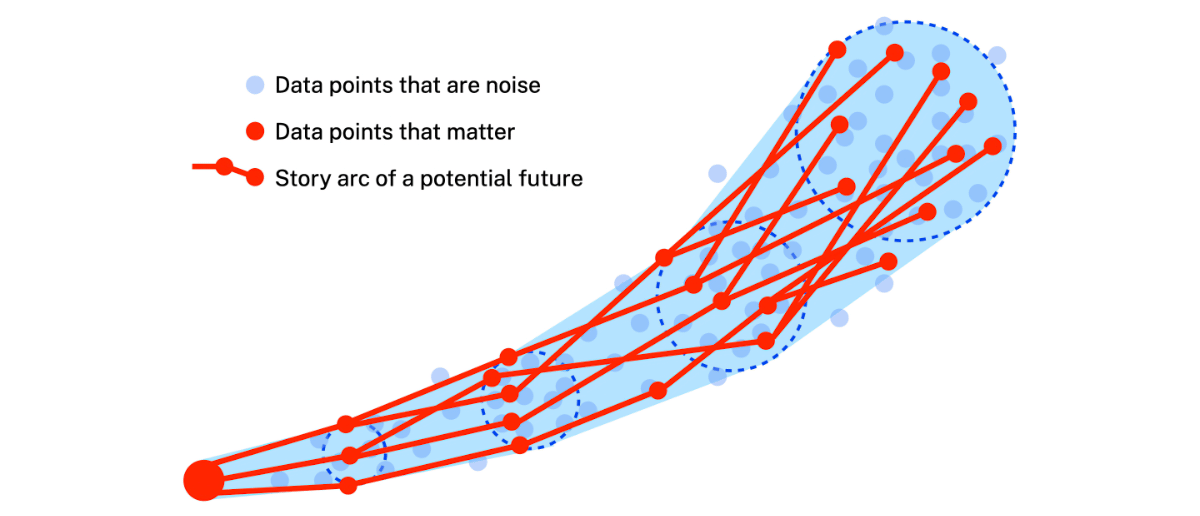

The “art” of being a futurist is to narrow the cone of uncertainty by ignoring all the story paths that aren’t as likely. (Obv!) But how do you know what’s real and what’s noise? One way is to read as much as you can, talk to as many people as possible, and fill the rest of your time listening to podcasts. That might work, but it could also mean you spend 40+ hours a week “studying the future” which leaves you with even more story threads to consider. Plus you probably have a day job and personal life you don’t want to ignore.
Instead, there’s a much simpler approach:
Move your starting point further up the cone
Alan Kay (1970s Xerox PARC) said, “The best way to predict the future is to invent it.” William Gibson (1990s cyberpunk novelist) said, “The future is already here—it’s just not evenly distributed.” My version (2020s Citrix) fuses the two: “The best way to predict the future is to start living it.”
I experiment and use AI in my daily work in a way that’s at least 6 months ahead of mainstream workers. Maybe more. So my “starting point” (where everything is known) is also 6+ months ahead of the mainstream. This effectively narrows my cone at every point past that. I don’t have to be smarter to see further, I just need to stand closer!
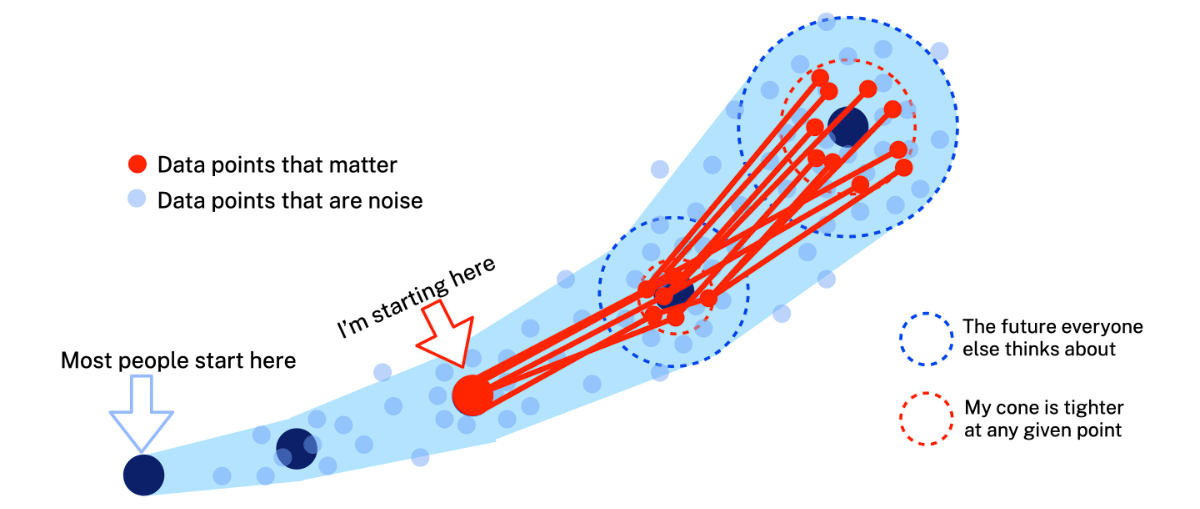

This isn’t a surprise for those who’ve always been forward thinkers. Even in our EUC world, when we first started using Citrix in the 1990s, it was instantly clear that it was a better way to secure and deliver apps than what the mainstream was doing. When we first used virtualization in our labs in the early 2000s, we knew this was how every server would operate in the future. And when we recognized the benefits of SaaS and the cloud in the 2010s, we mentally moved into that world while the mainstream tech media pontificated on costs, adoption curves, and hype.
All of this is the same with AI.
On the podcast last week (audio | video), I talked about how it’s impossible to truly comprehend what using AI is like more than one step ahead of wherever you are on the 7-stage human-AI collaboration roadmap. If you’re living at Stage 1 (where most of the workforce is today), you might somewhat understand Stage 2, but Stages 3+ might as well describe living on Mars. Therefore your personal cone of uncertainty for the future is significantly larger than someone who’s currently living in Stage 3.
To see the future, you need to live the future
I’ve built a second brain. I work through a cognitive stack. I’m deeply in Stage 3 (moving into Stage 4) on my 7-stage roadmap. I’ve integrated my second brain with others. At this point I’m not really even forecasting the future, I’m just telling stories about my daily life. Most peoples’ “future of work” is just another Tuesday for me.
Once you understand how the rest of the world will experience AI over the next 6-12 months, you can use that to frame your answers to the bigger questions, like:
- What if everyone ends up working this way? What if almost nobody does?
- What if AI capability keeps compounding at this pace? What if it plateaus tomorrow?
- What if compute gets too cheap to meter? What if it gets scarcer and more expensive?
- What if the labs lose funding? What if funding is increased?
- What if the best models are limited or banned? What if open models are limited or banned?
- What if the world’s ability to crank out new chips is curtailed? What if the supply chain limitations are gone in a few years?
- What if the world remains energy constrained? What if we end up with an abundance of energy?
You can explore dozens of scenarios for each question, then ask yourself, “What elements are the same in every one?” (Which would, at minimum, be everything you’re living today.) Second brains are real. The cognitive stack is real. Supercharging AI with personal and organizational context is real. AI using computers, apps, and interfaces designed for humans is real. Costs for equivalent AI compute is really decreasing 99% per year. And so on . . .
What won’t change?
The final technique I incorporate into my future thinking is attributed to Jeff Bezos: “Rather than asking what will change, ask what will stay the same. Then build your strategy around those constants.” (I explored this fully a few months ago in the post, What’s left for humans?)
For AI specifically, coming up with a list of “what stays the same” is pretty straightforward. A couple examples off the top of my head:
- Regardless of future AI capabilities, models, vendors, or economics, the workers using AI still need to be authenticated.
- The agents acting on their behalf still need to be governed.
- The data those agents touch still needs to be protected.
- Someone, somewhere, still needs to answer the questions of what ran, who told it to run, and what it touched.
- Regulation & compliance will still dictate certain aspects of what must be human and what limits AI have.
- Regulations, geopolitics, social appetites, and availability of technology can flip overnight.
Your next moves
So now you have all the required elements to build a thinking framework for yourself. The next time a piece of AI news lands which feels like it might change your roadmap, ask two questions:
- Does this actually shift the cone of plausible futures, or is it just another data point inside the cloud where it already was?
- Does it change any of the invariants? (The things you believe to be true no matter how this plays out.)
If the answer to both is no, file it under “interesting” and move on with your week. (This is probably 95% of the headlines.)
The people and companies who win the next few years won’t be the ones who guessed the next dot. They’ll be the ones who saw where the dots were going, identified what survives in every plausible future, and started building for that while everyone else was arguing about meaningless headlines. Much of it might be boring plumbing today, but focusing there beats chasing AI moonshots that depend on a single version of the future coming true.
Read more & connect
Join the conversation and discuss this post on LinkedIn. You can find all my posts on my author page (or via RSS).