

Download the Citrix Workspace App
Citrix Workspace app is the easy-to-install client software that provides seamless secure access to everything you need to get work done.
Citrix drives 88% faster login speeds to EMR and extends hardware lifecycle by 2 years for this multi-state health system
Contact us at citrixvoc@cloud.com
Healthcare is a connected enterprise and St. Luke’s University Health Network understands this better than most. With 23,000 employees and 16 campuses, St. Luke’s needs to deliver lightning-fast access to patient records and keep costs under control.
faster access to medical records with Citrix
year extension to hardware refresh cycle with Citrix
healthcare users connecting to EMR through Citrix each day
Working to the tightest of budgets, St. Luke’s has become a master of connected care. The key to its operation, providing healthcare services across Pennsylvania and New Jersey, is making sure care teams can access, share, and update patient records in real time.
This is made possible through St. Luke’s engagement with Citrix. By leveraging the Citrix platform, St. Luke’s ensures its entire workforce has secure, reliable access to its electronic medical records (EMR) system, Epic™. And as a result of fast and reliable access to Epic™, staff can deliver higher standards of care, remaining focused on the patient, and keeping patient safety paramount.
Access to Epic™ isn’t just secure and reliable; it’s also incredibly fast.
Before implementing Epic™, St. Luke’s relied on a roaming desktop solution which was slow to load and launch the EMR. By leveraging the Citrix platform, clinicians can now access records 88% faster, getting to critical patient information in under five seconds.
“Every second counts in healthcare,” says Jeff Stone, Chief Technology Officer. “Those saved seconds go straight back to patient care.”
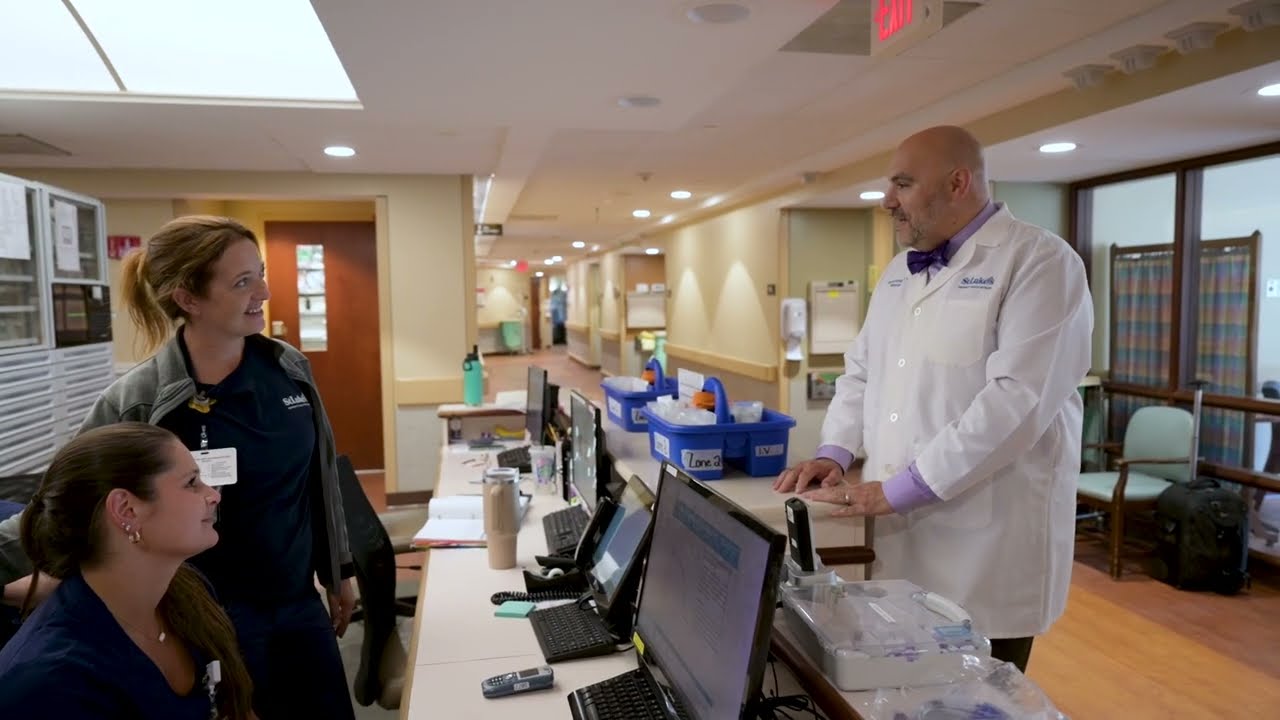
Today, care teams can walk up to any one of St. Luke’s 9,500 devices, use their badge to log in, and immediately get to work with up-to-date Epic™ records. This seamless mobile working is the backbone of connected healthcare at St. Luke’s.
Every second counts in healthcare, those saved seconds go straight back to patient care.”
Digital transformation, Stone continues, can help deliver new operational efficiency and new standards in patient care. But for transformation to gain traction, it needs users on board.
“Our clinical teams love Citrix,” he says. “Citrix is now part of their standard, daily processes. Positive feedback from users generates the momentum we need to keep exploring new technology.”
St. Luke’s is open to innovation, Stone says, and is happy to pioneer new ideas. The strength of the Citrix platform provides assurance that new applications can be delivered efficiently and effectively.
“The close alignment between Epic™, Microsoft, and Citrix is a huge factor in our success. Microsoft is a big part of our AI and cloud strategy; Epic™ runs seamlessly on the Citrix platform. Continuity of technology will help accelerate our transformation,” he explains.
Citrix simplifies the management of applications in a constantly growing environment, allowing the business to scale its digital workflows without needing to add headcount. Citrix enables Kurt Royer, a system architect at St. Luke’s, and his team of three, to manage application access for upwards of 20,000 users each day.
It is not only Epic™ that Citrix delivers, Royer adds: “There are all kinds of third-party applications that are business critical, as well as Epic™. Being able to centrally manage version controls on our endpoints, with everything inside of a data center or region, has been huge. From a security standpoint, if something is installed that isn't supposed to be installed, we just reboot a server and get back to the state we need to be in. Being able to lock down the Citrix sessions so that no file transfers can be done to the local endpoint is key to securing our data and mitigating risk.”
Our clinical teams rely on Citrix, it has been and continues to be a large part of their infrastructure standard, and daily automation processes. Positive feedback from users generates the momentum we need to keep exploring new technology.”
St. Luke’s has always been an innovative organization, with technology at the heart of its business strategy; it was one of the first healthcare providers in the region to move to the cloud. It now works out of two Azure data centers, a primary site in Virginia with a backup in Illinois. This move was in part to strengthen business resiliency, and part a cost exercise.
The engagement with Citrix is no different. By consolidating on the Citrix platform, St. Luke’s has been able to deliver maximum value from its licensing agreement, whilst optimizing efficiency. “The ability to use thin clients helps us wring maximum lifecycle out of our devices. We’ve extended our hardware refresh cycle by two years with Citrix,” Stone admits. “As a non-profit we need to do all we can to optimize our investments, particularly in non-medical technology.”
In addition, Citrix NetScaler enables St. Luke’s to efficiently scale and optimize applications across any environment. Applications are delivered faster, with a better experience for end users and more cost-efficient use of application servers. A single dashboard allows Royer’s team to quickly remediate issues.
“All our Epic™ load balancing goes through NetScaler,” says Royer. “We have NetScaler deployed in almost any region or data center, whether that is inside of Azure or on-premises. Any application that requires load balancing, we leverage NetScaler.”
All our EMR load balancing goes through NetScaler. We have NetScaler deployed in almost any region or data center, whether that is inside of Azure or on-premises. Any application that requires load balancing, we leverage NetScaler.”
St. Luke’s prizes the ability to move quickly. The business is acquisitional. Thirty years ago, it had three campuses, today there are 16 and further acquisitions are likely.
“Citrix makes it possible to move the environment of an acquired hospital very quickly,” says Royer. “Before we moved to Azure and Citrix DaaS, ordering, installing, and deploying the necessary hardware and servers could take six months. Now we can provision the required capacity on-demand, significantly accelerating the deployment process.”
“If we’re making an acquisition,” Stone adds, “we want to realize the value of that investment as quickly as possible. Citrix makes that possible, by enabling the rapid deployment of standardized St. Luke’s workflows while maintaining seamless access to legacy EMRs and applications, even when hosted across different domains and networks. Accelerating the implementation of our standards helps reduce costs and enhance patient care.”
Epic is a registered trademark of Epic Systems Corporation
Citrix makes it possible to move the environment of an acquired hospital very quickly. Before we moved to Azure and Citrix DaaS, ordering, installing, and deploying the necessary hardware and servers could take six months. Now we can provision the required capacity on-demand, significantly accelerating the deployment process.”